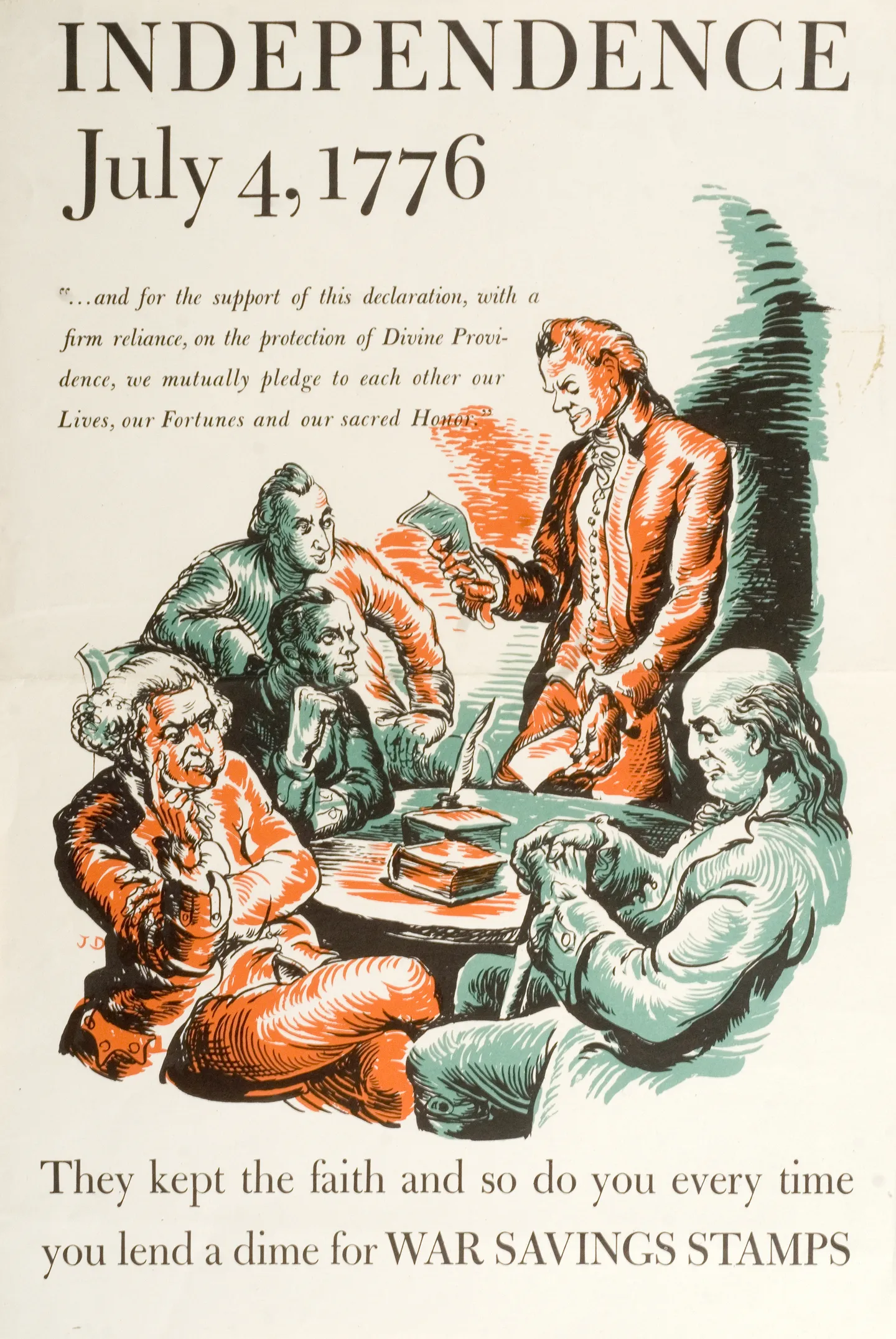
“Revolutionary” World War II Savings Stamp Poster
A 1942 poster created by the U.S. government with American Revolution-themed imagery encouraging Americans to support the war effort
Historical Period
America and a World at Warcontributing partner

About
This poster, created in 1942 by the U.S. government, encouraged Americans to buy war savings stamps, a type of loan made by citizens to the government with the promise of repayment with interest. The U.S. government used war savings bonds and war savings stamps to help finance World War II. Savings bonds were typically purchased in larger dollar amounts, anywhere from $25 to $1,000. To appeal to children and lower-income Americans, the government also sold savings stamps. Savings stamps cost less than the bonds, anywhere from 10 cents to $5. If a collector of savings stamps purchased enough stamps, they could trade them in for a savings bond. The poster—one of a collection of four featuring American Revolution-era imagery and themes—includes an excerpt from the Declaration of Independence and an illustration of several founders to appeal to patriotic feelings.
Start Prepping for Class
Customize this page for your students' needs or grab ready-to-go assets and take it all to class
“Revolutionary” World War II Savings Stamp Poster
Viewing:
Analysis Questions
Foster inquiry and understanding with these source-specific questions, designed to be accessible even for those with limited background knowledge.
say hello to the source
-
1
Look over the document, without reading it closely. What do you notice?
-
2
What types of documents have you seen that resemble this source?
make observations
-
3
This source references the adoption of the Declaration of Independence. What details in the source support this claim?
-
4
This poster was created by the U.S. government during World War II. A war savings stamp is a type of small loan made by citizens to the government with the promise of repayment with interest. Based on this information, what is the goal of the source?
interpret what you see
-
5
Why might the source’s creator have selected this quote from the Declaration of Independence? What does it suggest about their views on U.S. involvement in World War II?
-
6
What does the phrase “They kept the faith and so do you” mean? Why do you think the source’s creator makes this comparison?
-
7
What connections does the poster make between the American Revolutionary War and World War II?
-
8
During this time period, Black Americans were subjected to widespread bigotry. Jim Crow laws in the South mandated segregation, and discrimination in wartime industries limited job opportunities. Meanwhile, people of Japanese descent were forced into internment camps and were denied their civil rights during World War II. Given this information, why might this poster be considered hypocritical or in conflict with the reality of many Americans during this period?
use it as evidence
-
9
Why might sources such as this poster help historians understand what was meaningful to the government and Americans at the time?
-
10
Who might this poster have appealed to? What makes you say that?
Vocabulary
Use these related vocabulary terms to build students’ understanding and support more meaningful discussions and learning outcomes in your classroom.
start customizing
A new way to prep for class
Every source on history.org can now be customized by you! Adjust text, change the layout, add questions, remove others, and style it for every learner in your room — then share or export in one click.
Teach It Your Way
Add context, remove complexity, and adjust the text to match the way you teach.
Style for Your Classroom
Adjust text size, spacing, and structure so the content fits your students' needs.
Spark & Guide Discussions
Scaffold discussion and support for every learner with the language they need to engage.
Build with Vetted Content
Easily pull in additional sources, videos, and context directly from the history.org library.
Citation & Details
Citations
- Creator: Daugherty, James Henry, 1889-1974
- Date Created: ca. 1940
- Materials and Measurements: 1 colored poster 45 x 31 cm.
- Point of Origin: Washington, DC, U. S. Govt. print. off.
- Object Identifier #: P&E L2010F70
- Citation Label: The Society of the Cincinnati, The Robert Charles Lawrence Fergusson Collection.
Sources used to create the comprehension questions include:
National Museum of the United States Air Force. (n.d.). Liberty Bond and War Saving Stamps Leaflets. https://www.nationalmuseum.af.mil/Visit/Museum-Exhibits/Fact-Sheets/Display/Article/579630/liberty-bond-and-war-saving-stamps-leaflets/
National WWII Museum. (n.d.). Stamping Out the Enemy: U.S. Postal War Savings Stamps. https://www.nationalww2museum.org/sites/default/files/2020-04/Elementary%20-%20Stamping%20Out%20the%20Enemy-War%20Savings%20Stamp%20Math_0.pdf
UNT Digital Library. (n.d.). Lexington, 1775, they fought for freedom, we fight to keep it; Independence, July 4, 1776, they kept the faith and so do you every time you lend a dime for war savings stamps; John Paul Jones said, "I have not yet begun to fight", fight with war stamps & bonds; Washington crossed the Delaware to win our freedom, we cross oceans to keep it. https://digital.library.unt.edu/ark:/67531/metadc338/
Virginia Museum of History & Culture. (n.d.). World War II Stamp Corsage (c. 1942). https://virginiahistory.org/learn/world-war-ii-stamp-corsage-c-1942
Related Educational Videos(1)
Found in This Collection, 1 items
There’s even more for Beta Users
Get Access to Everything
More Primary Sources In:
America and a World at War
Photograph of George Washington’s Birthday Celebration

Margaret Hall and a Soldier Standing Outside an American Red Cross Canteen Tent

Trotsky Ice Axe
Four Rotor Enigma Machine
Silk Map
Bicycle® Escape Map Cards
Pigeon Camera

Glass Eye Concealment Device