Letter to John Ford [6 March] 1860
An 1860 letter describing the tension in Lynn, Massachusetts, during a massive strike by shoemakers
Historical Period
Expansion, Slavery, and Calls to Reformcontributing partners
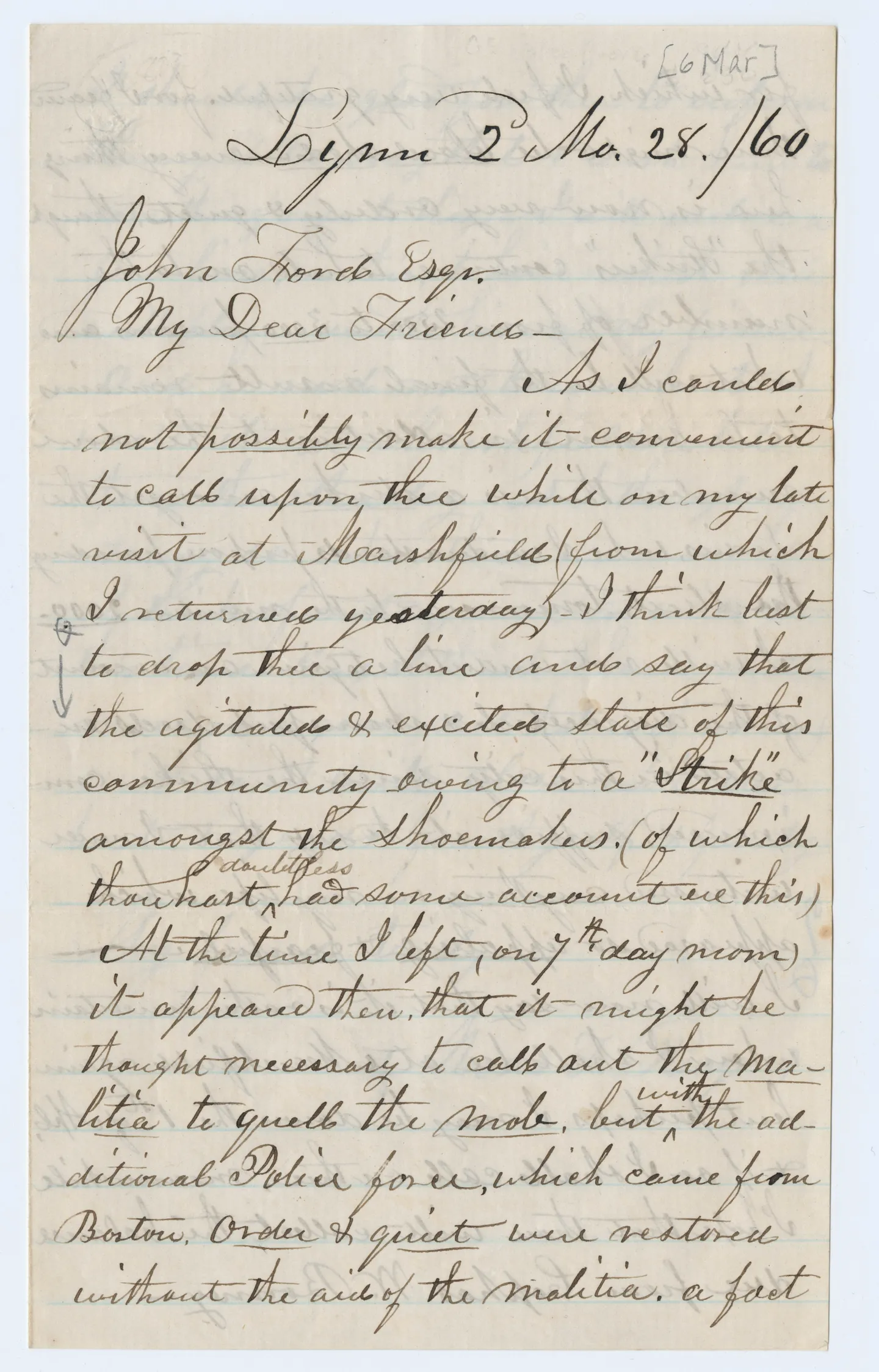
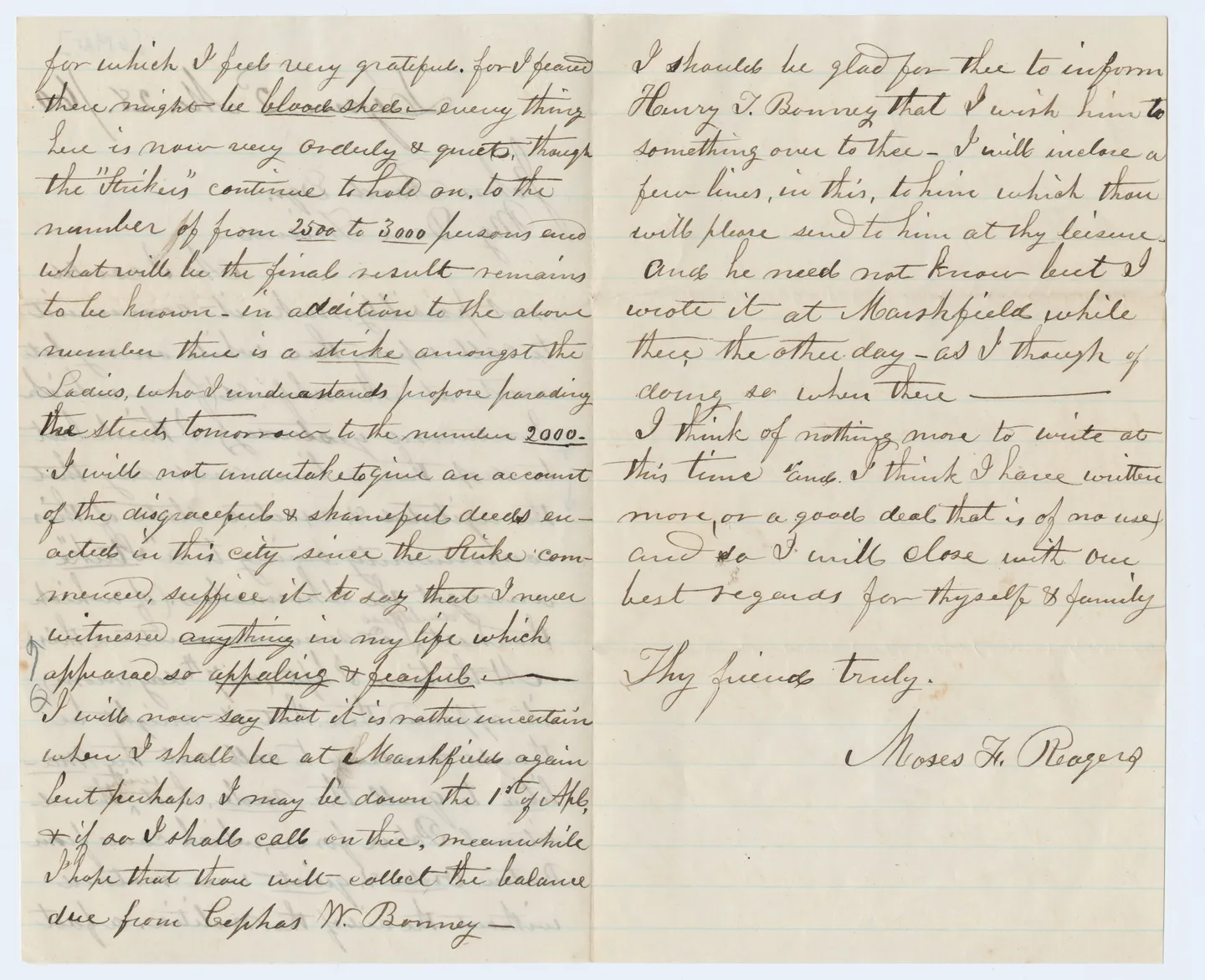
Letter to John Ford [6 March] 1860.
John Ford Esq.
My Dear Friends–
As I could
not possibly make it convenient
to call upon thee while on my late
visit at Marshfield (from which
I returned yesterday) I think best
to drop thee a line and say that
the agitated & excited state of this
community owing to a “Strike”
amongst the shoemakers (of which
thou hast ^doubtless had some account in this)
At the time I left (on 7th day morn)
it appeared then, that it might be
thought necessary to call out the ma-
litia to quell the mob, but ^with the ad-
ditional Police force, which came from
Boston, order & quiet were restored
without the aid of the malitia, a fact
for which I feel very grateful, for I feared
there might be blood shed – every thing
here is now very orderly & quiet, though
the ‘Strikers’ continue to hold on, to the
number of from 2500 to 3000 persons and
what will be the final result remains
to be known. in addition to the above
number there is a strike amongst the
Ladies, who I understand propose parading
the streets tomorrow to the number 2000.
I will not undertake to give an account
of the disgraceful & shameful deeds en-
acted in this city since the Strike com-
menced, suffice it to say that I never
witnessed anything in my life which
appeared so appalling & fearful.
I will now say that it is rather uncertain
when I shall be at Marshfield again
but perhaps I may be down the 1st of April,
& if so I shall coll on thee, meanwhile
I hope that thou wilt collect the balance
due from [Cephas?] W. Bonney–
I should be glad for thee to inform
Henry J. Bonney that I wish him to
something over to thee. I will inclose a
few lines, in this, to him which thou
will please send to him at thy leisure.
And he need not know but I
wrote it at Marshfield while
there the other day–as though of
doing so when there.
I think of nothing more to write at
this time and I think I have written
more, or a good deal that is of no use
and so I will close with our
best regards for thyself & family
Thy friend truly,
Moses F. Rogers
Simplified text and excerpts coming soon!
About
On February 22, 1860, shoe workers in Lynn, Massachusetts, launched what became the largest strike in U.S. history to that date. As shoemaking shifted from an artisan craft to mass-production in factories, wages plummeted. This letter was written by Moses Folger Rogers, an eyewitness who viewed the strike with disapproval. Rogers describes an angry community and expresses fear of bloodshed as police were called to suppress the mob. The event captures the intense social conflict of the early Industrial age, revealing how the effects of industrialization divided entire communities and sparked an era of labor protest.
Start Prepping for Class
Customize this page for your students' needs or grab ready-to-go assets and take it all to class
Letter to John Ford [6 March] 1860
Viewing:
Analysis Questions
Foster inquiry and understanding with these source-specific questions, designed to be accessible even for those with limited background knowledge.
say hello to the source
-
1
Look at the handwriting in the primary sources document. How would you describe the style of the writing? What type of document is it?
-
2
Look at the physical condition of the paper. What might this tell us about the letter?
make observations
-
3
What does the appearance of the letter reveal about it?
-
4
Look at the words the author underlined in the letter. Why do you think the author chose to underline these words?
-
5
Read the transcript of the letter. How many people were involved in the strike, and what specific group does the author mention would be parading the streets the following day?
interpret what you see
-
6
In the transcript, the author, eyewitness Moses Folger Rogers, mentions feeling ”very grateful” that the militia was not needed. What does this reveal about the level of tension in Lynn, Massachusetts, during this period?
-
7
Based on this letter, what can be inferred about the role of women in the 19th century labor movement?
-
8
Why do you think the author put the word “Strikers” in quotation marks and referred to the group as a “mob”?
use it as evidence
-
9
The author describes the scenes in the city as “disgraceful,” “shameful,” ”appalling,” and “fearful.” What do these word choices reveal about the author’s perspective on the strike?
-
10
This letter documents the Lynn, Massachusetts, shoe workers’ launch of what became the largest strike in U.S. history to that date. Shoemaking had been a highly skilled artisan craft, but now machines were doing much of the work, so workers’ wages decreased. How does this letter serve as evidence of the social tensions created by the Industrial Revolution in the mid-19th century between artisans and mass-production in factories?
-
11
In the late 19th century, women did not enjoy the same rights and freedoms as they have now. What does the ”strike amongst the Ladies” reveal about how the Industrial Revolution changed the lives of women in New England?
Vocabulary
Use these related vocabulary terms to build students’ understanding and support more meaningful discussions and learning outcomes in your classroom.
start customizing
A new way to prep for class
Every source on history.org can now be customized by you! Adjust text, change the layout, add questions, remove others, and style it for every learner in your room — then share or export in one click.
Teach It Your Way
Add context, remove complexity, and adjust the text to match the way you teach.
Style for Your Classroom
Adjust text size, spacing, and structure so the content fits your students' needs.
Spark & Guide Discussions
Scaffold discussion and support for every learner with the language they need to engage.
Build with Vetted Content
Easily pull in additional sources, videos, and context directly from the history.org library.
Citation & Details
Citations
- Creator: Rogers, Moses Folger
- Date Created: 6 March 1860
- Point of Origin: Lynn, Massachusetts
- Object Identifier #: Misc. 1860 March 6
- Alt Text: cursive handwriting in black ink on aged paper
- Citation Label: Letter from Moses F. Rogers to to John Ford, 6 March 1860, manuscript. Massachusetts Historical Society
Sources used to create the comprehension questions include:
Martin, S. (2016, June 29). The Lynn Shoemakers’ Strike of 1860. Massachusetts Historical Society. https://www.masshist.org/beehiveblog/2016/06/
Robin, C. (2014, May 1). Going on strike? The weird origins of the word labor unions use. History News Network. https://www.historynewsnetwork.org/article/going-on-strike-the-weird-origin-of-the-word-labor
Related Educational Videos(1)
There’s even more for Beta Users
Get Access to Everything
More Primary Sources In:
Expansion, Slavery, and Calls to Reform
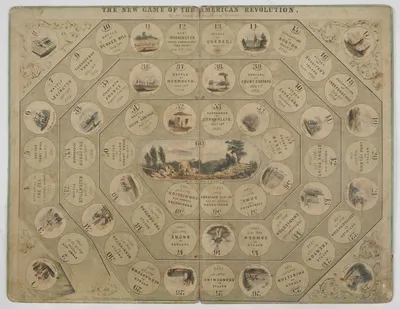
The New Game of the American Revolution
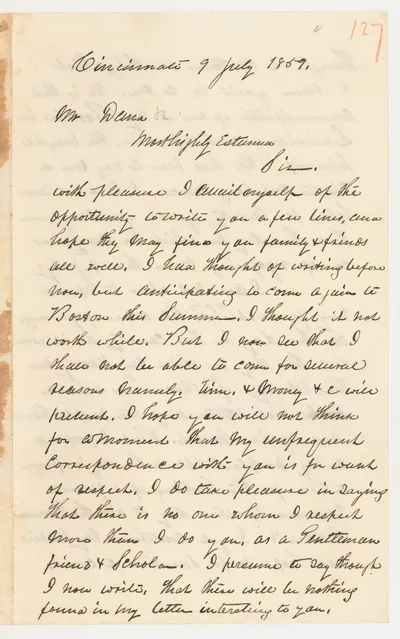
Anthony Burns Letter about the 4th of July
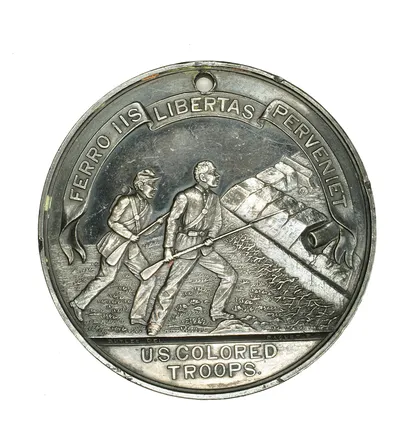
Colored Troops Before Richmond medal
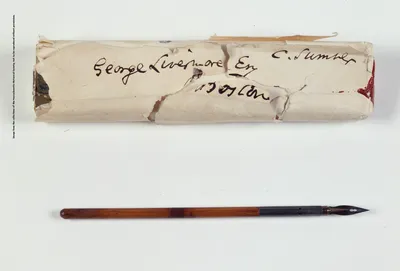
Pen used by Abraham Lincoln to sign the Emancipation Proclamation
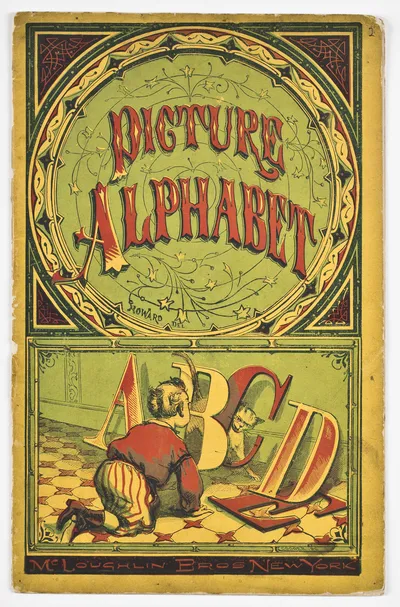
Picture Alphabet Book, c.1861-1870
Storage Jar

No Slavery! Fourth of July! The Managers of the Mass. Anti-Slavery Soc'y ...
A Gum, or Hollowed-Out Tree