Lord Dunmore’s Proclamation was issued in November 1775 by John Murray, the royal governor of Virginia, during the early months of the American Revolution. It declared that any person enslaved by a Patriot who escaped and joined the British forces would be granted freedom. This was a strategic move to weaken the rebellion by disrupting the colonial economy and encouraging enslaved people to flee and take up arms against the Patriots. The proclamation caused panic among colonial enslavers and inspired hundreds, possibly thousands, of enslaved individuals to seek freedom by attempting to run away and join Dunmore’s forces, though many faced harsh conditions and uncertain outcomes. It’s a powerful example of how freedom and loyalty were used as tools in wartime.

Creator:

John Murray, Earl of Dunmore

Date Created:

1775-11-24

Materials and Measurements:

Ink on antique laid paper; 42.5 x 25.5 cm

Point of Origin:

Williamsburg, Virginia

Object Identifier #:

SCNP1936

Citation Label:

Lord Dunmore's Proclamation (1775), The Virginia Gazette Number 43, November 23, 1775
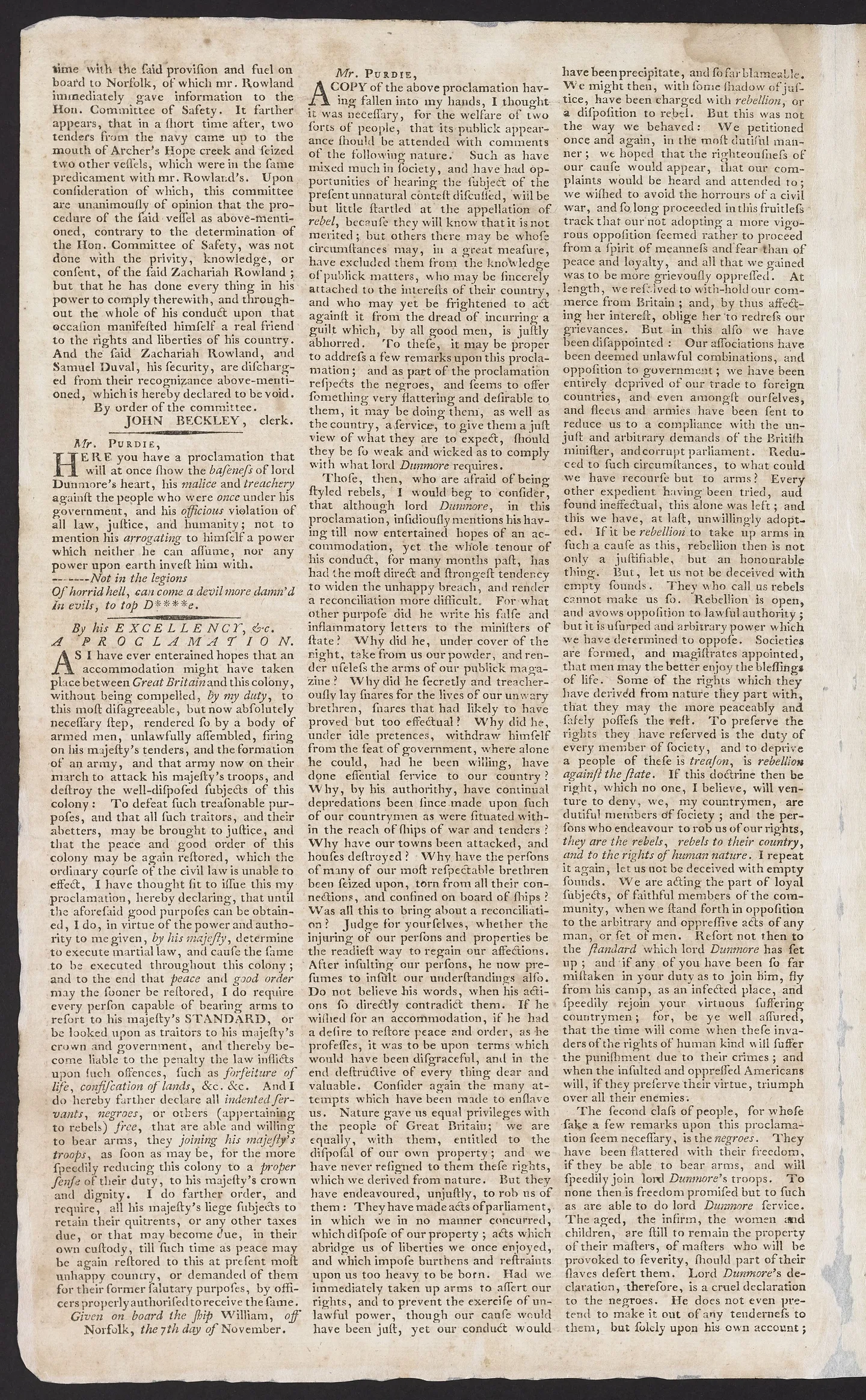
By his EXCELLENCY, &c.

A PROCLAMATION

AS I have ever entertained hopes that an accommodation might have taken place between Great Britain and this colony, without being compelled, by my duty, to this most disagreeable, but now absolutely necessary step, rendered so by a body of armed men, unlawfully assembled, firing on his majesty’s tenders, and the formation of an army, and that army now on their march to attack his majesty’s troops, and destroy the well-disposed subjects of this colony : To defeat such treasonable purposes, and that all such traitors, and their abetters, may be brought to justice, and that the peace and good order of this colony may be again restored, which the ordinary course of the civil law is unable to effect, I have thought fit to issue this my proclamation, hereby declaring, that until the aforesaid good purposes can be obtained, I do, in virtue of the power and authority to me given, by his majesty, determine to execute martial law, and cause the same to be executed throughout this colony ; and to the end that peace and good order may the sooner be restored, I do require every person capable of bearing arms to resort to his majesty’s STANDARD, or be looked upon as traitors to his majesty’s crown and government, and thereby become liable to the penalty the law inflicts upon such offences, such as forfeiture of life, confiscation of lands, &c. &c. And I do hereby farther declare all indented servants, negroes, or others (appertaining to rebels) free, that are able and willing to bear arms, they joining his majesty’s troops, as soon as may be, for the more speedily reducing this colony to a proper sense of their duty, to his majesty’s crown and dignity. I do farther order, and require, all his majesty’s liege subjects to retain their quitrents, or any other taxes due, or that may become due, in their own custody, till such time as peace may be again restored to this at present most unhappy country, or demanded of them for their former salutary purposes, by officers properly authorized to receive the same.

Given on board the ship William, off Norfolk, the 7th day of November.

document-cwf-proclamation-002
Download
document-cwf-proclamation-002
Download

Lord Dunmore’s Proclamation was issued in November 1775 by John Murray, the royal governor of Virginia, during the early months of the American Revolution. It declared that any person enslaved by a Patriot who escaped and joined the British forces would be granted freedom. This was a strategic move to weaken the rebellion by disrupting the colonial economy and encouraging enslaved people to flee and take up arms against the Patriots. The proclamation caused panic among colonial enslavers and inspired hundreds, possibly thousands, of enslaved individuals to seek freedom by attempting to run away and join Dunmore’s forces, though many faced harsh conditions and uncertain outcomes. It’s a powerful example of how freedom and loyalty were used as tools in wartime.

Creator:

John Murray, Earl of Dunmore

Date Created:

1775-11-24

Materials and Measurements:

Ink on antique laid paper; 42.5 x 25.5 cm

Point of Origin:

Williamsburg, Virginia

Object Identifier #:

SCNP1936

Citation Label:

Lord Dunmore's Proclamation (1775), The Virginia Gazette Number 43, November 23, 1775

By his EXCELLENCY, &c.

A PROCLAMATION

AS I have ever entertained hopes that an accommodation might have taken place between Great Britain and this colony, without being compelled, by my duty, to this most disagreeable, but now absolutely necessary step, rendered so by a body of armed men, unlawfully assembled, firing on his majesty’s tenders, and the formation of an army, and that army now on their march to attack his majesty’s troops, and destroy the well-disposed subjects of this colony : To defeat such treasonable purposes, and that all such traitors, and their abetters, may be brought to justice, and that the peace and good order of this colony may be again restored, which the ordinary course of the civil law is unable to effect, I have thought fit to issue this my proclamation, hereby declaring, that until the aforesaid good purposes can be obtained, I do, in virtue of the power and authority to me given, by his majesty, determine to execute martial law, and cause the same to be executed throughout this colony ; and to the end that peace and good order may the sooner be restored, I do require every person capable of bearing arms to resort to his majesty’s STANDARD, or be looked upon as traitors to his majesty’s crown and government, and thereby become liable to the penalty the law inflicts upon such offences, such as forfeiture of life, confiscation of lands, &c. &c. And I do hereby farther declare all indented servants, negroes, or others (appertaining to rebels) free, that are able and willing to bear arms, they joining his majesty’s troops, as soon as may be, for the more speedily reducing this colony to a proper sense of their duty, to his majesty’s crown and dignity. I do farther order, and require, all his majesty’s liege subjects to retain their quitrents, or any other taxes due, or that may become due, in their own custody, till such time as peace may be again restored to this at present most unhappy country, or demanded of them for their former salutary purposes, by officers properly authorized to receive the same.

Given on board the ship William, off Norfolk, the 7th day of November.

history.org logo
Powered By

made possible by the generous support of Jane P. Batten.

get in touch

P.O. Box 1776
Williamsburg, VA 23187

[email protected]

GET UPDATES

About Partners Contact
Privacy Policy Terms of Use