Clothing
: Women's Clothing
: A Colonial Lady's Clothing: A Glossary of Terms
Brunswick
A three-quarter length jacket worn with a petticoat, the Brunswick was an informal
gown or a traveling gown. It had a high neck, unstiffened bodice that buttoned,
long sleeves, and frequently had a sack back (loose pleats) and a hood. (See
also Jesuit)
Cap
The cap was worn by women and girls to dress their heads. It was a practical
piece that allowed the head to be dressed without styling the hair. At the same
time it protected the hair from everyday dust and dirt so that the hair need
not be washed as frequently. A hat was tied on top of the cap when going out.
The cap could be made of linen, cotton, or even all lace. Lace and ruffles could
be added to the cap. The style of fashionable cap changed frequently.
Cape
A protective outer garment that was shaped to the neck, covered the shoulders,
fastened at the center front and was usually shorter than a cloak. Made of either
heavy or light fabrics of wool, cotton, or silk.
Caraco
A jacket of many different styles worn in the second half of the 18th century.
It was worn with a petticoat and was considered day wear at home or for informal
activities. It was always considered "undress."

Cloak
A long, loose, unfitted, protective outer garment that fell from the neck and
the shoulders and was usually secured at the center front neck. Sometimes hooded,
and usually made of a heavy woolen fabric.
Dress
Dress in the 18th century referred to the overall fashion for everyone and not
a single garment. It was the total look from head to toe. Full dress would refer
to the most formal, fashionable look. Today the military's most formal uniform
is referred to as the full-dress uniform. (See also Fashionable Undress and
Undress)
Fashionable Undress
In the 18th century this referred to the less formal clothing for everyone,
but still in the best of fashion. Usually worn during the day. (See also Dress
and Undress)
Gown
Throughout the 18th century a woman's dress usually consisted of a gown and
petticoat. The gown consisted of the bodice and skirt joined together, with
the skirt open in the front to reveal the separate petticoat, which was an essential
part of the dress and not an undergarment. (See also Petticoat and Stomacher)
Hat
Worn for fashion and for protection against the sun, a lady out of doors almost
always wore a hat. A fashionable hat usually had a very shallow, flat crown
and a wide brim. Hats of chips or straw were the most popular from the 1730s
to the 1770s. There were many ways for them to be trimmed and trims would change
with the fashions. A straw hat might even be entirely covered with fabric. Ladies'
riding hats were often of felt and might be cocked like a gentleman's.
Jesuit
Similar to the Brunswick, but the skirt of the gown was full length. (See also
Brunswick)
Mitts or Mittens
In the 18th century mitts were elbow-length, fingerless gloves. Although there
was a thumb, it was open and the fingers were left free. They were usually cut
with peaked flaps over the knuckles. Embroidered floral motifs and fancy arm
openings were popular adornments. Heavy mitts gave warmth in winter and light
weight ones protected the arms from the sun in summer. In the winter the hands
could be kept warm with a muff.
Mob Cap
A mob was undress headwear; becoming popular in the 1730s and worn in some form
into the next century. It had a puffed crown placed high on the back of the
head, a deep flat border surrounding the face, and side pieces carried down
like short lappets, which could be left loose, pinned, or tied under the chin.
The flat border usually was frilled or had lace.
Muffs
Tube-like accessories used for keeping the hands warm, muffs were of various
sizes as dictated by fashion. They could be covered with fur, cloth, or feathers,
and were usually padded.
Pattens
Pattens were overshoes consisting of a raised sole standing on an iron ring,
with an adjustable strap used to secure them. Designed to lift the wearer's
shoes off the ground so as to protect them from soiling or damage when there
was wetness, mud, or muck. Pattens were worn by both men and women into the
early 20th century.
Petticoat
A woman's skirt-like garment worn with a gown or jacket. Most gowns were open-fronted
robes needing the addition of the petticoat to fill the gap. Quilted ones could
be worn for both warmth and fashion. Underpetticoats of linen, wool, or cotton
were added for warmth.
Riding Habit
A riding habit consisted of a petticoat, jacket, and waistcoat, or waistcoat
fronts attached to the jacket. The jacket followed the lines of men's coats
until the 1780s, except that it had a waist seam and bust darts. Habits were
suitable for traveling and fashionable undress.
Shift
The shift was the undermost garment worn by children and women. It served the
same purpose as the man's shirt. Made from various qualities of white linen,
it had either a drawstring or plain neck, as well as drawstrings or cuffs at
the elbows. It could be plain or lace trimmed.
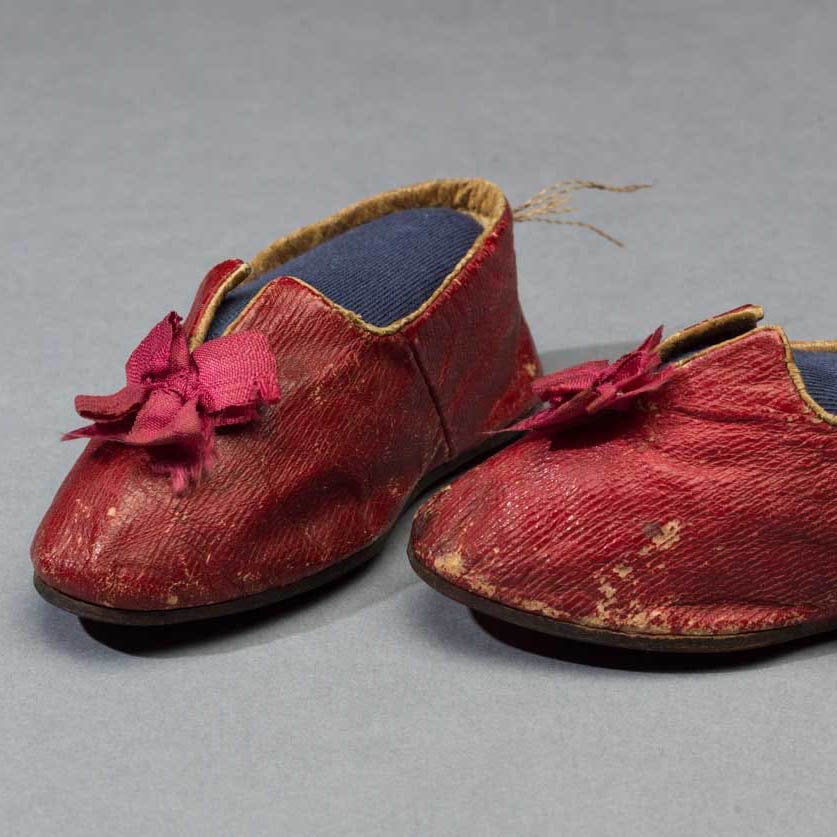
Shoes
Shoes were made of silk fabrics, worsteds, or leathers. Depending on current
fashions, they may or may not have had elevated heels. They would fasten by
buckles, clasps or, if very utilitarian they might have ties.
Short Gown
Loose T-shaped garments cut to the length of the hip or thigh. Made to wrap
or Bed Gown over in front and held together by pinning or held closed with the
apron. Made of utilitarian fabrics to be worn by the laboring sort and made
of better fabric for the middling sort and worn as undress.
Sleeve Ruffles
Ruffles were attached to the edge of the gown sleeves to cover the elbows.
Either plain or lace trimmed ruffles, the degree of decoration and the
number of ruffles varied with fashion.
Stays
Stays were the essential foundation garment of the 18th century. They developed
from the "boned bodies" of the 17th century, and in the 19th century
were to become corsets. But just as the names of these garments changed, so
did the shape and effect upon the body. The fashionable 17th century torso was
an elongated tubular trunk, with little taper and encased the bosom. Through
the 18th century stays covered the body with their conical form, lifting and
supporting the bosom. In the 19th century corsets created a curvelinear body,
minimizing the waist and accentuating the bosom. The stays of the 18th century,
therefore, did much more to support the body and remind one of good posture
than they did to cinch the waist. Women of the gentry and middling sorts wore
stays most of the time. Children of these classes also wore stays to learn proper
carriage. While fashionable ladies' stays were wanted for a good shape, working
women needed them for good support. All women were admonished by their contemporaries
to not tightly lace or "straight" lace their stays out of concern
for possible injury. Those who did so out of vanity were
mocked
by the satirical print to the right, entitled, "Tight Lacing or Fashion
before Ease." The extent to which stays were worn by slaves is unclear.
Plantation records do not indicate the use of stays in the yearly allotment
to field slaves. That some slaves, particularly house slaves, did wear stays
is proven by the many descriptions in runaway ads. As the sorts of women who
wore stays varied greatly, so did the types and quality of the garments themselves.
Frequently constructed in layers of linen with narrow strips of boning inserted
within, stays could vary from perfectly rigid to very pliable. Boning was either
baleen, metal, wood, pasteboard, or pack thread. Their exteriors could be covered
in fine silks, utilitarian worsteds, or plain linens. Perhaps the lowest sort
of stays were those given by church charity, generally made in a single layer
of thick leather. (See also Children's Clothing-Stays)
Stomacher
A triangular shaped piece of fabric used in the front of the gown to hold the
gown together. Sometimes soft, but might be stiffened, it would be attached
to the bodice lining by pins and tabs, hooks and eyes, or lacing. It might be
plain or highly trimmed. It could be made of the same fabric of the gown, or
of contrasting fabric and therefore might be worn with different gowns.
Tucker
A plain or lace ruffle stitched around the neck of a gown.
Undress
Undress in the 18th century referred to the everyday, utilitarian working clothes.

|