|
Publications: CW Journal: Past Issues: Spring 2001

Hanz Lorenz |
An Eighteenth-Century Williamsburg Craftsman Profiled
by Harold B. Gill Jr.
|
During my forty years of research on the artisans of eighteenth-century
Williamsburg, I have identified 570 gunsmiths, carpenters, brickmakers,
apothecaries and the like. But I had seen the face of only one of them
until last summer when a small watercolor portrait of cabinetmaker Edmund
B. Dickinson turned up.
An aged sheet of reinforced paper of 51¼2-by-51¼16 inches
records his likeness. He sits sideways in a chair, his arm over the
crest rail, in a half-length profile that catches a long, narrow, aquiline
nose. It looks to have been drawn in pencil, probably during the mid-1770s,
and the color added, the specialists say, in the nineteenth century.
The identity of the artist is unknown.
Dickinsons light brown or dark blond hair is caught up in a cue
at the back and curls over his ears. He wears a red waistcoat over a
white shirt and neckcloth. His coat and breeches are blue. The background
is a red-bordered black rectangle decorated at the corners by S-scrolls,
and there is a tan margin.

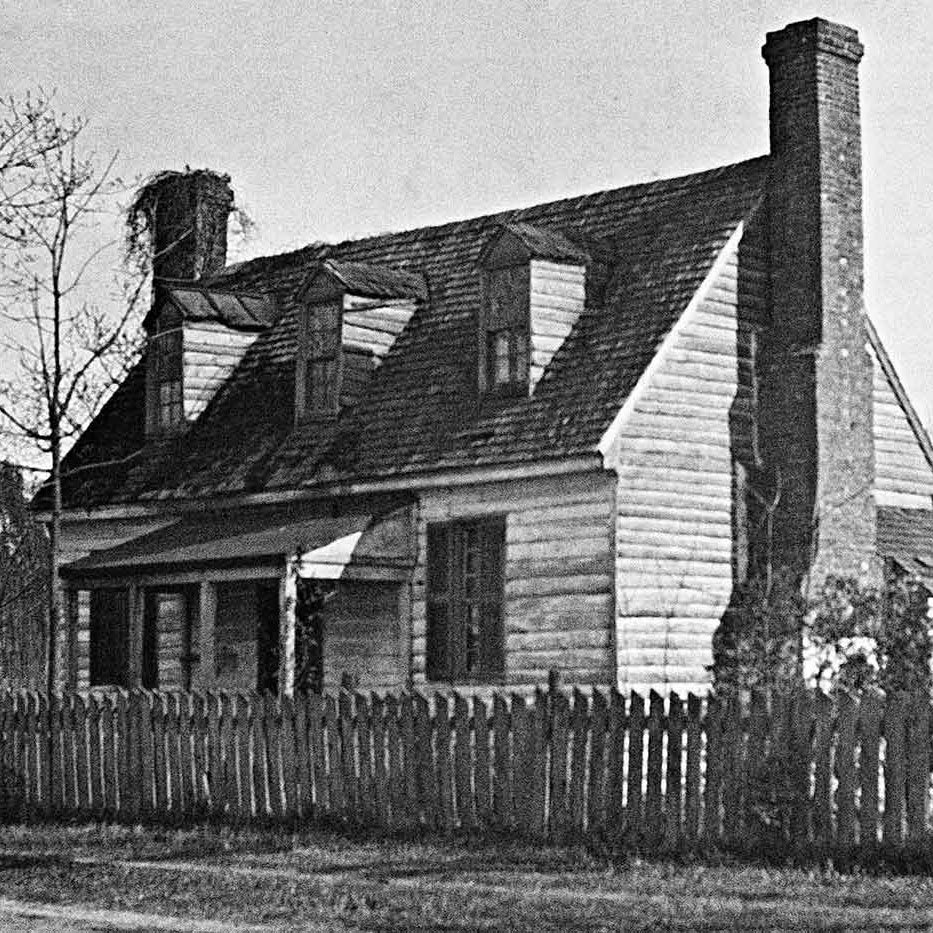
Astride a Historic Area ravine, the
reconsturcted Anthony Hay Shop stands where Edmund Dickinson made
furniture before leaving to fight the British.Dave
Doody
Inscriptions on the back identify the sitter, and documents associated
with the image show that it descended in a collateral branch of Dickinsons
family. In 1991, the image and the papers were presented to the Mary
Ball Washington Museum in Lancaster, on Virginias Northern Neck.
They were the gift of a distant kinswoman, Miss Althea Smart, in her
name and in the name of her late brother, R. Henry Smart. Most of the
papers record family efforts, based on Dickinsons military service,
to collect pensions and land grants.
|
Reading the book Southern Furniture, written by
the Colonial Williamsburg Foundations Ron Hurst and Jonathan
Prown, Mary Ball Washington Museum curator Cathy Currey noted
references to cabinetmaker Dickinson and made the connection.
Soon Phil Zea, curator of furniture, and Barbara Luck, curator
of paintings, drawings, and sculpture, were in Lancaster to have
a look. After appraisals, discussions, and approval by the Mary
Ball Washington Museum board, Colonial Williamsburg acquired the
portrait and the papers late in 2000.
Just one other likeness of an eighteenth-century Williamsburg
artisan was known to exist before the identification of the watercolor
of Edmund B. Dickinson. Portraits of printer John Dixon and his
wife survive, but not in Colonial Williamsburgs collections.
|

Attributed to the original
Anthony Hay Shop on Williamsburg's north side, this card table
appears in the late nineteenth-century picture below. Hans
Lorenz |
Williamsburgs restored houses and shops stand as examples of
the design and construction skills of its colonial-era artisans. The
centuries-old structures are sources of information about the careers
of the citys craftsmen and draw of them pictures of sorts. Some
craftsmen appear in the records a few times, and we have found a little
about them there. For others there are artifacts but no documentsor
documents but no artifacts. For instance, the business career of blacksmith
James Anderson is well recorded in official records, newspapers, and
account books. But no objects in the foundations collections can
be proved to have been made at his anvil. Likewise, the tailors and
shoemakers in town are known only through documents.
An open card table, stacked
with books, is
captured in this late nineteenth-century
photo of the front hall of what is toady called
the Tayloe House,a few lots west of the
Anthony Hay Shop. - Colonial Williamsburg |
The most numerous objects surviving from the hands of Williamsburg
artisans are the copies of the Virginia Gazette and the books
produced by Williamsburg printers and bookbinders. Some silver
objects in Colonial Williamsburgs possession demonstrate
the skill of the citys silversmiths and engravers. Furniture
made by the hands of local cabinetmakers has been identified and
acquired, too.
An elaborate Masonic chair signed by Benjamin Bucktrout has a
prominent place in the foundations collections. Other pieces
have been traced to the shops of Williamsburg cabinetmakers Peter
Scott and Anthony Hay.
With all the surviving products these people made, we know something
of their lives. But we didnt know what any of them looked
like.
|
One of Anthony Hays employees in 1764 was the young Edmund B.
Dickinson of the portrait.We dont know Dickinsons age, but
he was likely an apprentice at the time. Norfolk-born, he was the son
of Thomas Dickinson, and it was probably Hays reputation as a
high-class cabinetmaker that attracted Edmund to Williamsburg.
Hay provided many Virginians with fine furniture. For about twenty
years, from at least as early as 1748, he worked in the shop that is
now reconstructed on Nicholson Street. By late 1766, Hay seems to have
contracted cancer of the faceperhaps from mahogany dustand
decided to take up tavernkeeping. In January 1767, Bucktrout announced
in the Gazette that he had taken over Hays cabinetmaking business:
Williamsburg, Jan. 6, 1767
Mr. Anthony Hay Having lately removed to the Raleigh Tavern, the
subscriber has taken his shop, where the business will be carried
on in all its branches. He hopes that those Gentlemen who were Mr.
Hays customers will favour him with their orders, which shall
be executed in the best and most expeditious manner. He likewise
makes all sorts of Chinese and Gothick Paling for gardens and summer
houses.
N. B. Spinets and Harpsicords made and repaired.
Benjamin Bucktrout.
Hay assured the cabinetmaker shops customers that:
THE Gentlemen who have bespoke Work of the Subscriber may depend
upon having it made in the best manner by Mr. Benjamin Bucktrout,
to whom he has given up his business. I return the Gentlemen who
have favoured me with their custom many thanks, and am
Their most humble servant,
Anthony Hay.
Hay purchased the Raleigh Tavern on Duke of Gloucester Street and ran
it until his death in 1770. In December, his obituary appeared:
Williamsburg, Dec. 13
On the 4th instant died, of that painful and lingering disorder
a cancer, Mr. Anthony Hay, master of the Raleigh tavern in this
City. He underwent several severe operations, in his lip and face,
for the disorder, at home; and at length went (unhappily too late)
to Prince Edward, where he was some time under the care of Mrs.
Woodson, famous for the cures she has made. His death is a heavy
loss to his large family, to whom he was a tender husband and kind
parent; and he is regretted by his acquaintances, as being a good
citizen and honest man.
|
Dickinson likely continued to work in the shop with Bucktrout
and may have had a hand in the making of the Bucktrout Masonic
chair. There are two more Masonic chairs in the lodge at Fredericksburg,
Virginia, that appear to have been made by Dickinson. Bucktrout
operated the cabinet shop until Hays death when the business
was put up for sale. In January, 1771, Dickinson announced that
he had acquired it:
EDMUND DICKINSON, CABINET MAKER, Williamsburg, Informs
the publick that he has lately opened the SHOP formerly occupied
by Mr. Anthony Hay, where may be had all Sorts of CABINET
WORK. Those Gentlemen who please to favour him with their
Orders may depend on their Work being well and punctually
executed.
Later that year he offered good Encouragement for
journeymen cabinetmakers, and the following year James Tyrie was
apprenticed to him to serve five years. The business prospered
and Dickinson again needed extra hands:
|
A chair thought to have
been made at the cabinetmakers when Dickenson ran the shop.
One of the few examples of pre-Revolution
chairs made in America with neo-classical ornamentation, reproductions
are displayed
today at the Peyton Randolph House parlor.
-Hans Lorenz |
Journeymen Cabinetmakers who are well acquainted with their
Business, will meet with good encouragement by applying to me in
Williamsburg.
Edmund Dickinson
Dickinson provided many prominent Williamsburgers with furniture. When
Governor Patrick Henry was refurnishing the Palace in 1776, Dickinson
sold him pieces to the sum of £90. He performed such other services
as fitting locks on chests, putting up bedsteads, gilding picture frames,
and mending tables and chairs. Like other cabinetmakers, he also made
coffins and arranged funerals.
This tea table came from
the Hay Shop during
the period when Dickinson worked there.
It belonged to Governor Dunmore. - Hans Lorenz
|
Though we know where he worked, we cannot say where he lived.
He owned 250 acres of woodland within seven miles of Petersburg
that he offered for sale in 1771, but found no buyers. On May
10, 1776, the year Dickinson became an officer in Americas
new army, he advertised for the recovery of a gray horse strayed
from York Town. In Williamsburg the following November 15,
Benjamin Weldon announced that the tenement in this city
lately occupied by Capt. Edmund Dickinson would be leased
to the highest bidder.
On February 4, 1776, the Virginia Committee of Safety unanimously
elected Dickinson Captain of the recruits to be raised in
the . . . District of York. Made up of men from Williamsburg
and York County, it was the 10th Company of the 1st Virginia Regiment
of Foot in the Continental service.
|
From February to August 1776 the regiment trained in Williamsburg under
Brigadier General Andrew Lewis. On August 16, the regiment marched north
to join George Washingtons Grand Army in New Jersey. During the
next two years, the 1st Virginia Regiment was successively part of Weedons,
Lord Stirlings, Mercers, and Muhlenburgs brigades.
On October 26, 1777, Dickinson was appointed a field officer with the
rank of major. He wintered that year at Valley Forge.
On May 9, 1778, in the only document in Dickinsons hand that
survives, he wrote to his sister Lucy in Williamsburg:
Dear Girl
I embrace this opportunity to communicate a few sentiments to you
as well as inform of the Joy circulating through our Camp at the
Glorious news from France which I make no doubt has reached your
City by this time tis no less than an offer of Alliance from
France & Spain on the most Honourable terms possible. I make
not the least doubt but it will cause a Peace before the leaves
(which now are just buding out here) falls from their tinder Sprigs.
Understand by Billy Nicolson my shirts are comeing on which I thank
you most kindly for have desired him to supply you with cash when
you may want it as well as your Sister Agnes your provider will
direct the proper use of it give my compliments to Mrs. Craig &
Husband &c &c &c
When you write to your York correspondent you will present my compliments
to her & Family while I subscribe myself
Your [lov]ing Brother
Edmund B. Dickinson
Camp Valley Forge
May 9th 1778
Less than two months later, Major Dickinson fought in New Jersey at
the Battle of Monmouth, the last major battle of the Revolution in the
North.
|
Sir Henry Clinton, the new British commander in America, had
been forced by the threat of Americas new alliance to abandon
Philadelphia. With an army of about sixteen thousand, he marched
for the safety of New York. Washington, with about as many men
in his command, was close on his heels, and General Horatio Gates
was hurrying down from the north to engage the vanguard of the
fleeing Redcoats.
General Charles Lee, who commanded five thousand of Washingtons
Americans, was ordered to strike Clintons rear guard and
hold the British while the commander in chief, three miles away,
hurried forward with the rest of the Continentals to smash the
English. There was the bright promise of a decisive victory. Lee,
however, refused to attack, and was attacked instead. By the time
Washington arrived, Lees corps were routed.
|
Dickinson's letter from
Valley Forge - Tom Green
|
Washington checked their flight, rode straight to Lee, called him a
damned poltroon, took command, and treated the British to
a sharp fight near Monmouth Courthouse. The 1st Virginia Regiment played
a crucial role by counterattacking the British right flank and relieving
the pressure on General William Alexanders wing. Driven back,
the British escaped in the night.
Seventy-two American officers and men died during the battle, among
them Major Dickinson. His death was reported in the English Universal
Magazine. Washington believed he had lost a valuable officer.
Arrested, court-martialed, convicted, Lee was suspended from rank for
twelve months. Ultimately, as much for affronts he offered Congress
as for his conduct at Monmouth, he was dismissed from the Army.
General Charles Scott was later asked if Washington ever lost his temper.
He said, Yes, once. It was at Monmouth and on a day that would
have made any man swear. Yes, sir, he swore on that day till the leaves
shook on the trees, charming, delightful. Never have I enjoyed such
swearing before or since. Sir, on that ever-memorable day, he swore
like an angel from Heaven.
Dickinson died a bachelor. His will left his personal property and
real estate to his two unmarried sisters, Agnes and Lucy, and £20
to his sister Mrs. Judith Farrer. He left £30 to another married
sister, Mrs. Elizabeth Warren, and reserved £60 out of his estate
so that his nephew Thomas Warren may be put to a good School Master
or masters if Sister Warren will incline.
Among the familys papers is a poem. There is no way to know who
was the author. It sounds as if it is something that could have been
penned by Lucys York correspondent, the female to
whom Dickinson asked his sister to present his compliments in the letter
from Valley Forge. It is impossible to say. It reads:
Come my Heavnly Muse descend
Caliope to thee! I bend,
Warble forth in sweetest Lays
And sacred Truth my Edmunds praise,
Sing the greatness of his soul
His Native goodness Sense & Worth
Shew in short throughout the whole
All thats good & grand on Earth,
Dearest favorite of my heart
May we meet no more to part,
But United fondly prove
Purest Joys of Constant Love
There is a note at the end: This I wrote 6 months ago, for Gods
sake take care of it, & let not a creature see it.
It may be that Lucy inherited Dickinsons portrait. Later the
wife of Robert Gibbons, she could have passed it to their daughter Louisa,
the wife of William Smart. Their son William Robert Smart, born in 1827,
would have gotten it next and passed it to his son Edmund Dickinson
Smart, born in 1869. Althea and R. Henry Smart, the Mary Ball Washington
Museum donors, were his children.
On the back of the portrait are brown ink inscriptions written in two
hands, perhaps the majority of the lines by sister Lucy and the last
three by William Robert Smart. They read:
Major Edmund B. Dickinson
Killed at Battle of
Monmouth
June 28th 1778
He was a brother of Lucy, the
wife of Robert Gibbons, who
was the mother of Louisa Gibbon
who married Wm Smart, who
was the father of Wm R. Smart.
Below, in the second hand, a note reads:
This picture belongs to
Edmund Dickinson Smart son of
W R Smart
Dickinsons personal estate was appraised at a little more than
£164. It included cabinetmakers tools, drawing instruments,
a Mason apron, and a New Rifle Gun. He also
owned books, among them eight volumes of the Spectator, four volumes
of the Tatler, Boyers French Dictionary and Grammar, Quintessince of
Poetry and Chippendales Designs. The New Rifle Gun
and Chippendales Designs were valued at £6 apiece. The settlement
of his entire estate showed it was worth more than £2,200.
To people who study Williamsburgs eighteenth-century artisans,
his portrait is almost priceless.
Williamsburg historian Harold
Gill contributed The Spanish Attempt a Jesuit Mission
to the Indians of Virginias Chesapeake Bay to the winter
journal. He is the author of such authoritative books and monographs
on Williamsburg tradesmen as The
Apothecary and Artisans
in Williamsburg, 17001800.
Suggestions for further reading:

|  |