Page content
View related multimedia and linksPlay Booth Theater
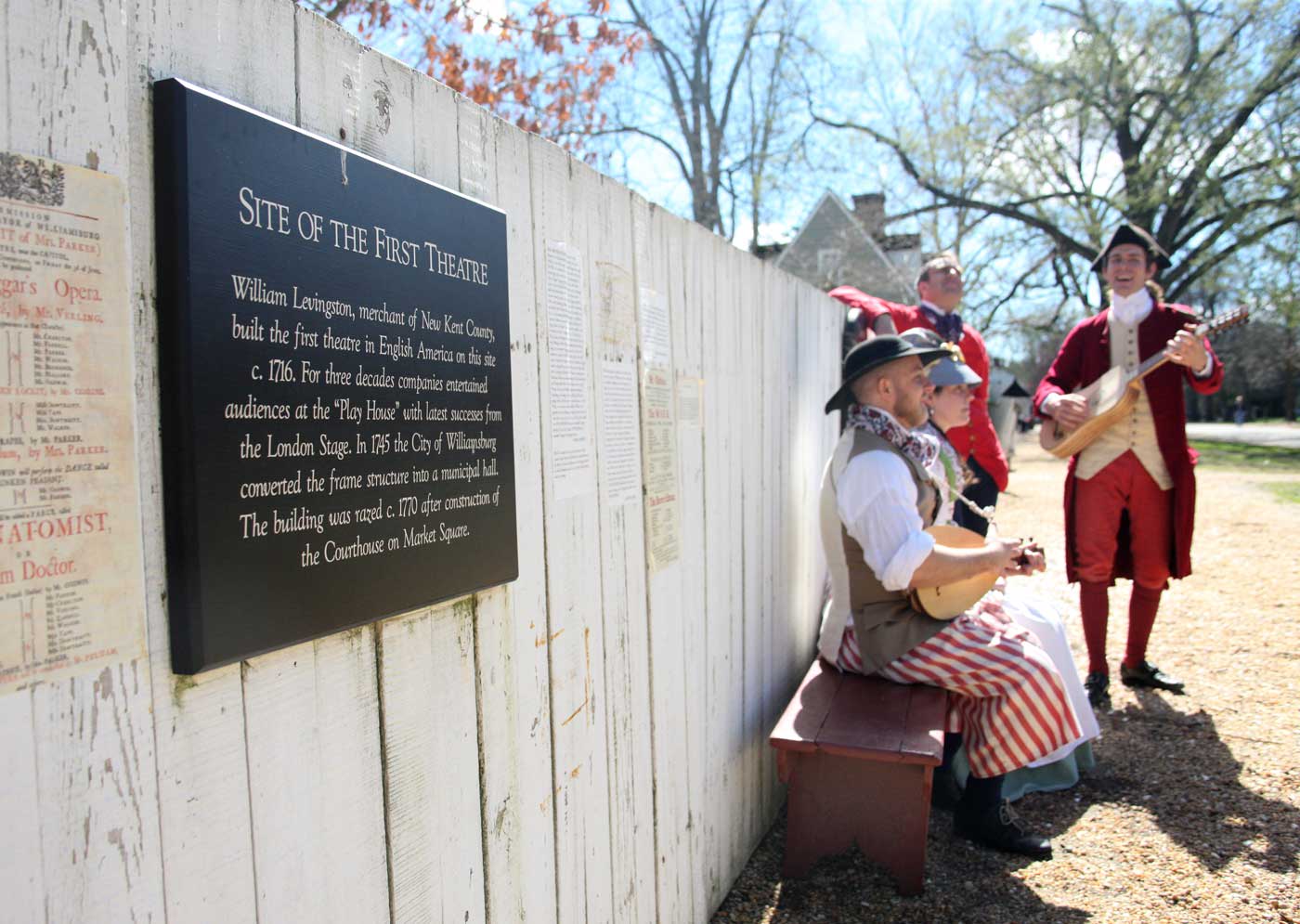
The drawing is a conjectural reconstruction of an 18th-century theater. The original playbill is for The Beggar’s Opera, which was first performed in Williamsburg in 1768. Peter Pelham, organist at Bruton Parish Church, supervised the musical part of the program
- Open-air stage for comedy performances on Palace Green
- American performing tradition inaugurated by William Levingston
- First play in honor of king's birthday
- William & Mary students performed plays in theater
- Second theater constructed behind Capitol near Waller Street
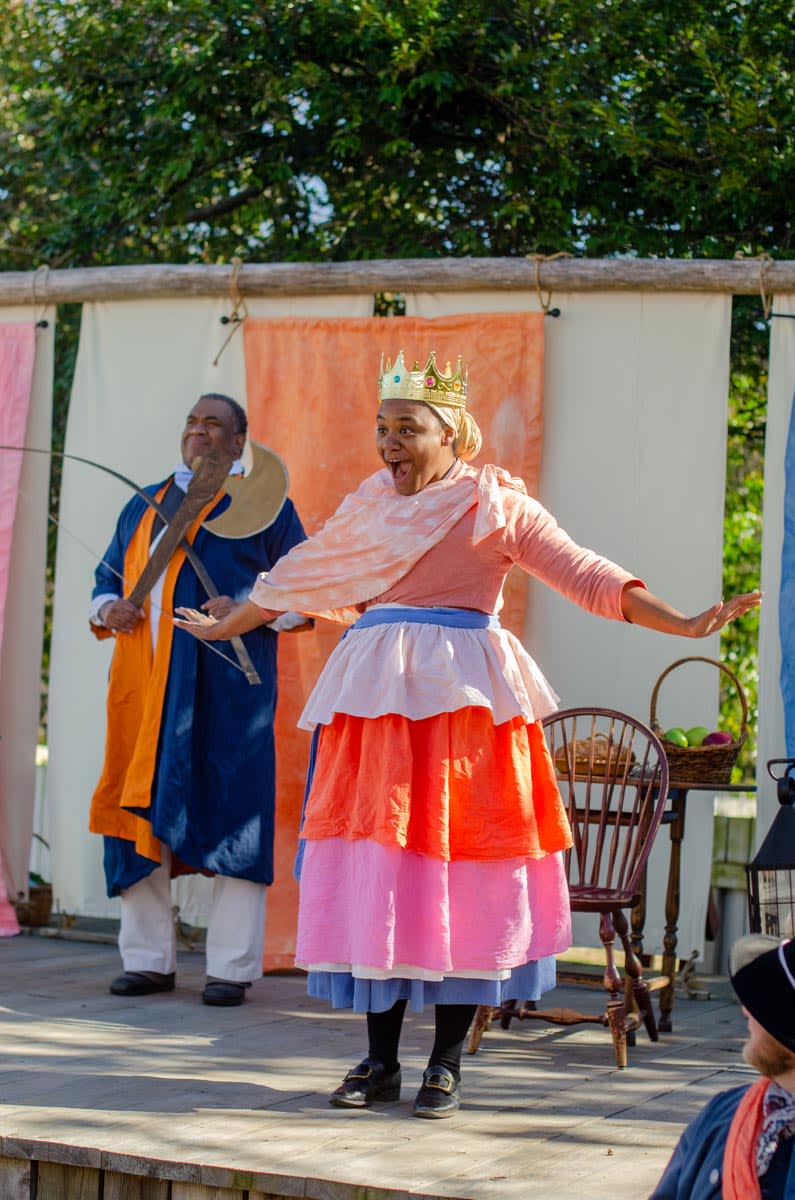
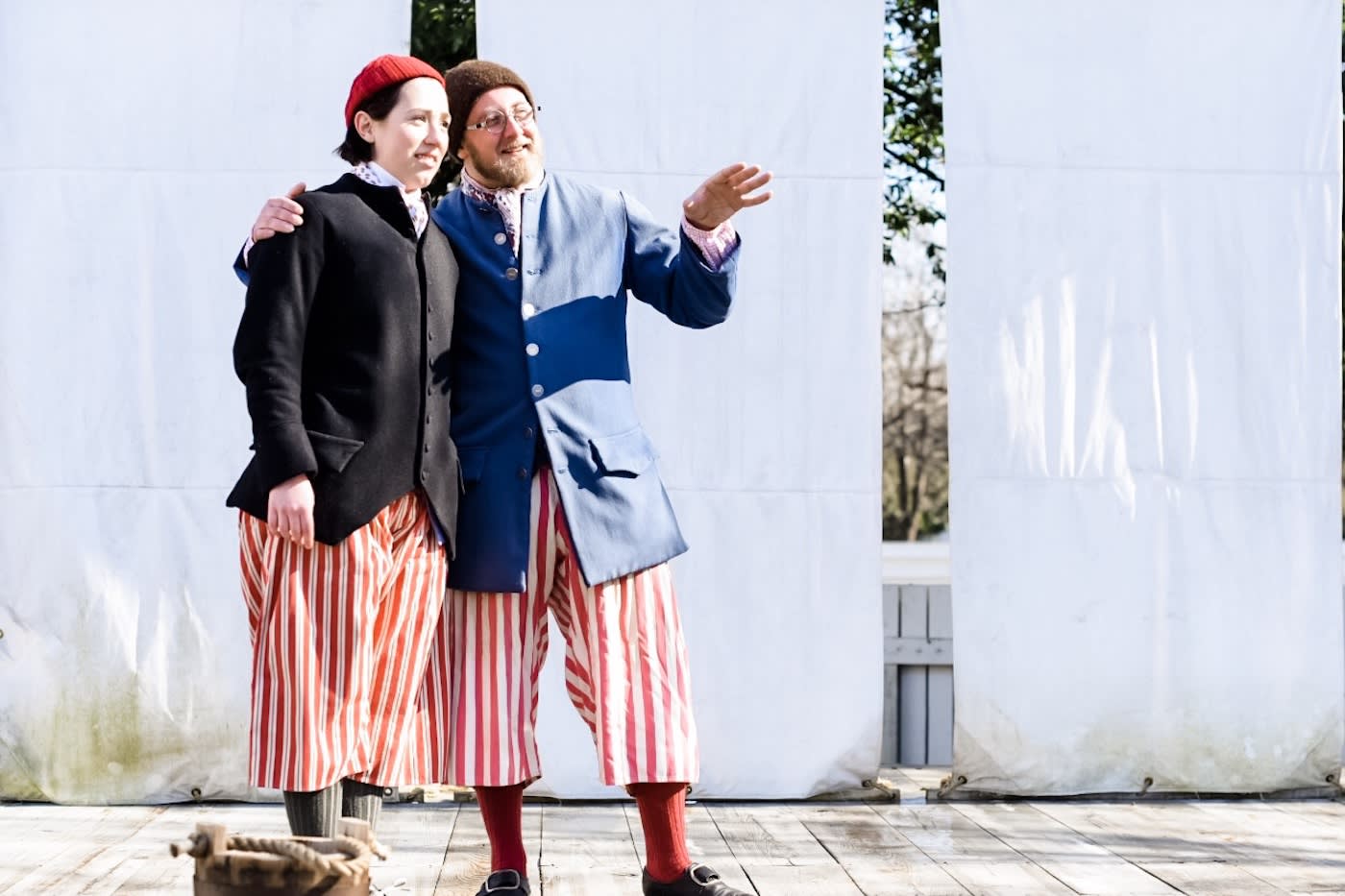
Open-air stage presents 18th-century farces
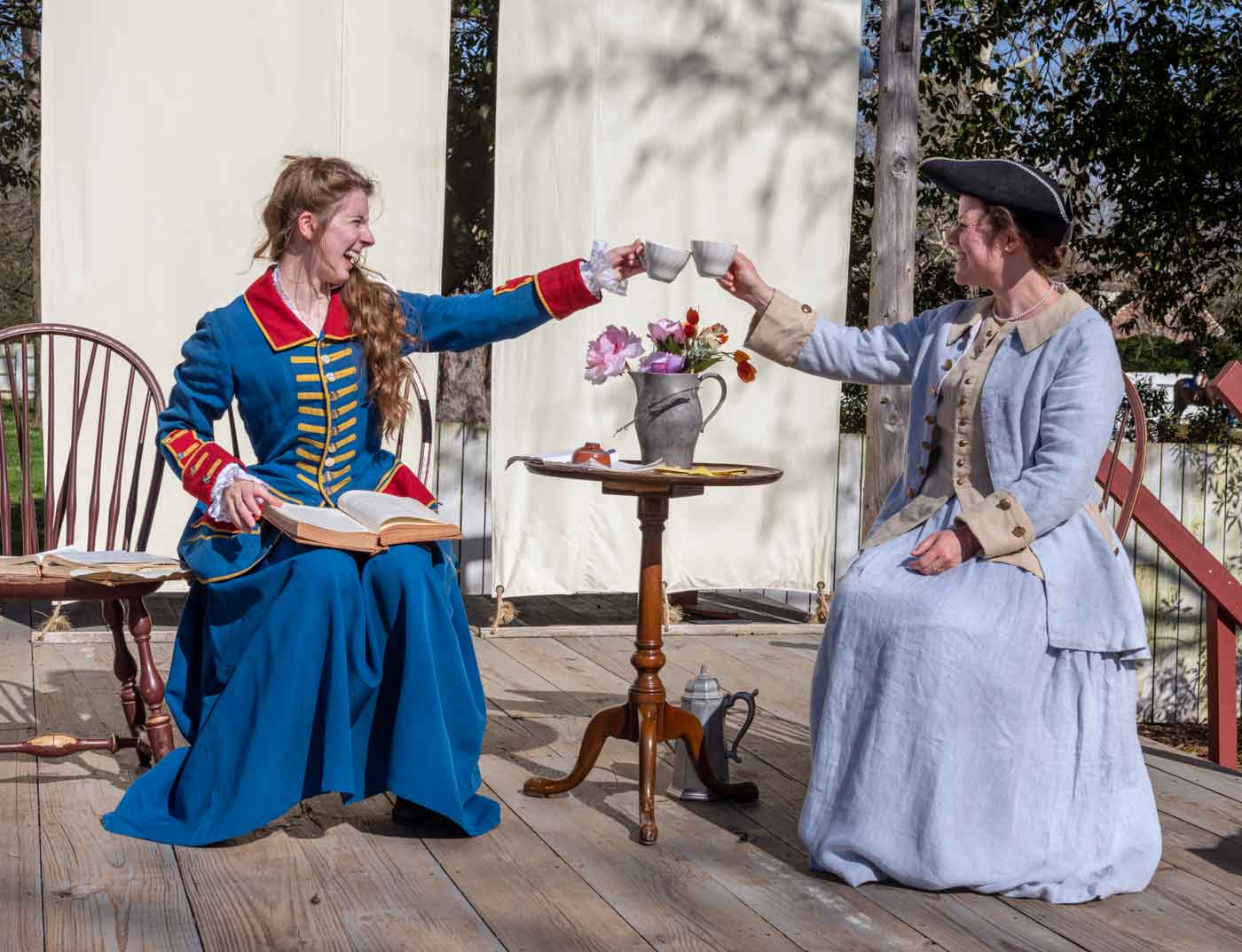
An open-air stage for Williamsburg Company of Comedians performances, the Play Booth Theater stands on Palace green. There, weather permitting, the troupe presents scenes from 18th-century farces. Play booths like this one popped up in 18th-century Williamsburg for public events on fair days. The company embodies an American performing tradition inaugurated here by merchant William Levingston of neighboring New Kent County.
William Levingston first proprietor of Play Booth
Levingston became the nation's first playhouse proprietor at least in part by virtue of a contract recorded on November 19, 1716. In it, he agreed
"to cause to be erected & built at his own proper Costs and Charge in ye City of Wmsburgh one good substentiall House commodious for acting such Plays as shall be thought fitt to be acted there."
Also parties to the agreement were Levingston's former indentured servants Charles and Mary Stagg. They obligated themselves to perform on his stage and to teach their craft to other aspirants to the boards. In addition, Charles Stagg bound himself to join Levingston in a petition for
"a Patent or a Lycence from ye Governour of Virga for ye sole Priviledge of acting Comedies, Drolls, or other Kind of Stage Plays within any part of ye sd Colony."
First recorded performance in honor of King George I
Governor Alexander Spotswood wrote that he sponsored a performance at Levingston's in honor of the birthday of King George I in 1718, the earliest record of a play in the first theater building on Palace Green.
Archaeological investigation unearthed the foundations of the first theater and showed that the playhouse was 30 feet wide, 86.5 feet long, and at least two stories tall – comparable to English provincial theaters of the day. Archaeological work at the third theater site near the Capitol revealed a much more substantial building, which Colonial Williamsburg plans to reconstruct.
Levingston out of business by 1727
Levingston was a man who played many parts in his time. A dancing master, he briefly leased a room at the Wren Building. A tavern keeper, he ran an ordinary in his house on the three-lot theater site. He also kept a bowling green. In 1721, however, he mortgaged the properties to Archibald Blair, and by 1727 it appears Levingston was out of business. By the mid 1730s, Dr. George Gilmer Sr. owned the lots and ran an apothecary shop on the corner.
College students performed plays in theater
In 1736, a cast of William and Mary students performed The Tragedy of Cato in the hall, and there were subsequent amateur performances of The Busy Body, The Recruiting Officer, and The Beaux Stratagem. But in 1745, Gilmer sold the playhouse to a public-spirited group of subscribers for £50 to be used as the city hall and the municipal court. Bids for the building's renovation were solicited in the Virginia Gazette that December 19. Nine years later, Gilmer was elected mayor and was once again in charge of the building.
Levingston's playhouse torn down following courthouse construction
Williamsburg's second theater opened by 1752 behind the Capitol near Waller Street. Levingston's playhouse was razed after construction of the Courthouse on Market Square. In 1788, his house was moved around the corner and became part of the St. George Tucker House. The reconstructed Levingston Kitchen – an example of the outbuildings that served his household and now a private residence – adjoins the Play Booth Theater.
The drawing is a conjectural reconstruction of an 18th-century theater. The original playbill is for The Beggar’s Opera, which was first performed in Williamsburg in 1768. Peter Pelham, organist at Bruton Parish Church, supervised the musical part of the program.
Multimedia and related links
-
Podcasts
- View descriptions
-
Colonial Theater
Todd Norris talks about Colonial Williamsburg's live performances, staged in the streets of Colonial Williamsburg's Historic Area as often as in its theaters. October 23, 2006
Audio podcast: Listen (mp3) | Transcript
Image enhanced: View (m4a) | Transcript
-
Educating Through Theater
Making connections with hundreds of curious minds every day makes Hope Smith feel like a teacher with Colonial Williamsburg's Historic Area as her classroom. October 2, 2006
Audio podcast: Listen (mp3) | Transcript
Image enhanced: View (m4a) | Transcript
-
Passion, Romance, and Intrigue in "Othello"
Themes of jealousy, passion, and betrayal in Shakespeare's "Othello" are as gripping today as they were in the 18th century, says Performing Arts Manager Todd Norris. March 12, 2007
Audio podcast: Listen (mp3) | Transcript
Image enhanced: View (m4a) | Transcript
-
Wit's Last Stake
Eighteenth-century farce delights 21st-century audiences. Todd Norris describes timeless comic themes. March 17, 2008
Audio podcast: Listen (mp3) | Transcript
Image enhanced: View (m4a) | Transcript
-
Cry Witch, Part Two
Hear the verdict in the trial of Grace Sherwood, the "Virginia Witch." October 29, 2007
Audio podcast: Listen (mp3) | Transcript
Image enhanced: View (m4a) | Transcript
-
Cry Witch, Part One
Take a seat at the trial of Grace Sherwood, the "Virginia Witch." October 22, 2007
Audio podcast: Listen (mp3) | Transcript
Image enhanced: View (m4a) | Transcript
- more...
- Quicktime 7 (free) is required to view the enhanced and video podcasts.
- Subscribe to our podcast RSS feeds:
Audio | Image enhanced | Video
-
Journal articles
-
Beyond Applause
Photo Essay
-
Gossip, Flattery, and Flirtation
The Art of Eighteenth-Century Letter Writing
-
Stuff and Nonsense
Myths That Should by Now Be History
-
"With All the Grace of the Sex"
Women in Trades
- more articles...


